Treatment
Whether you have targeted therapy and immunotherapy will depend on:
the type of mouth or oropharyngeal cancer you have
how far the cancer has grown (the stage)
treatment you may have already had
whether your cancer show (express) certain proteins
Some drugs work in more than one way. So they are targeted as well as working with the immune system.
You might have a targeted drug for squamous cell mouth and oropharyngeal cancer that is locally advanced if you can't have chemotherapy.
You might also have it for squamous cell mouth cancer that:
has come back (recurrent or relapsed cancer)
has spread to other parts of the body (metastatic cancer)
You might have immunotherapy for squamous cell mouth and oropharyngeal cancer that:
has come back (recurrent or relapsed cancer)
has spread to other parts of the body (metastatic cancer)
Read about types of mouth and oropharyngeal cancers
Doctors can look for certain proteins on the surface of your mouth and oropharyngeal cancer cells. They help the cells to grow and divide. They can look for the programmed cell death ligand 1 (PDL-1) checkpoint protein.
They usually test a sample of your mouth and oropharyngeal cancer tissue from when you were first diagnosed. Or from your operation if you had one.
The results of the tests show whether immunotherapy is suitable for you.
If your cancer has a particular protein on its surface, your doctor will call it positive for the protein. For example, PDL-1 positive.
Cetuximab is a targeted cancer drug used for mouth and oropharyngeal cancer. It is a type of targeted drug called a monoclonal antibody. It targets the epidermal growth factor receptor (EGFR) and blocks it.
EGFR is a protein on the surface of cells. It helps the cells to grow and divide. Some cells have a fault in the EGFR gene. This causes it to signal to the cancer cells to divide and make more copies (replicate).
By blocking this protein, cetuximab stops the cancer cells from growing.
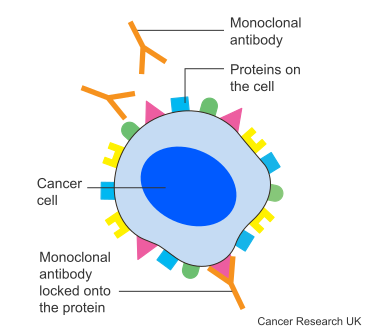
Read more about monoclonal antibodies
You might have cetuximab:
with radiotherapy for locally advanced squamous cell mouth and oropharyngeal cancer
with platinum chemotherapy for squamous cell mouth cancer that has come back or has spread to other parts of the body (metastatic)
Pembrolizumab and nivolumab are immunotherapy drugs called PD-1 inhibitors. They target and block a checkpoint protein called PD-1 on the surface of T cells. Checkpoint proteins are found on the surface of cells. PD-1 is found on the body's T cells, and PD-L1 is found on normal and often cancer cells. PD-1 means programmed cell death protein 1, and PD-L1 means programmed cell death ligand 1.
PD-L1 usually binds with PD-1. When PD-L1 on a cancer cell binds with PD-1, it prevents the T cell from recognising the cell as a cancer cell. The T cell sees it as a normal cell and leaves the cell alone. So, it prevents the T cell from killing the cancer cell.
Blocking the binding of PD-L1 to PD-1 with drugs called immune checkpoint inhibitors allows the T cells to recognise and kill cancer cells.
Go to more information about checkpoint inhibitors
You might have pembrolizumab if you have squamous cell cancer that has been tested for a type of protein called programmed cell death ligand 1 (PD-L1) and either:
you haven’t had any treatment for an advanced cancer
your cancer has come back and you can’t have surgery to remove the cancer
Or you might have pembrolizumab before and after surgery for locally advanced cancer.
You might have pembrolizumab on its own or with other cancer treatments.
You have nivolumab if you have squamous cell cancer and:
your cancer has come back or has spread to other parts of the body
you had platinum based chemotherapy (such as cisplatin or carboplatin), and your cancer has started to grow within 6 months of having chemotherapy
In Scotland, the Scottish Medicines Consortium (SMC) says that you can have nivolumab if your cancer continues to grow while on or after having platinum based chemotherapy.
You can have immunotherapy for up to 2 years.
New cancer drugs are licensed for use in a particular way. For example, a drug might have a license to treat a particular stage of cervical cancer.
Once a drug has a license, several independent organisations approve the new cancer drugs before doctors can prescribe them on the NHS.
In England, the National Institute for Health and Care Excellence (NICE) decides which drugs and treatments are available on the NHS.
In Wales, the All Wales Medicines Strategy Group (AWMSG) advises NHS Wales. They generally follow NICE decisions but can also issue their own guidance.
The Scottish Medicines Consortium (SMC) advises NHS Scotland. Its decisions are separate from decisions made by NICE.
Not all targeted and immunotherapy drugs are available throughout the UK. It might depend on where you live whether you can have a certain drug. Your doctor can tell you what drug is available for you.
You have treatment through a thin short tube (a cannula) that goes into a vein in your arm each time you have treatment.
Or you might have treatment through a long line: a central line, a PICC line or a portacath. These are long plastic tubes that give the drug into a large vein in your chest. The tube stays in place throughout the course of treatment.
Everyone is different and the side effects vary from person to person. The side effects you have depend on:
which drug you have
whether you have it alone or with other drugs
the amount of drug you have (the dose)
your general health
A side effect may get better or worse during your course of treatment. Or more side effects may develop as the treatment goes on.
For more information about the side effects of your treatment, go to the individual drug pages.
Last reviewed: 09 Sept 2024
Next review due: 09 Sept 2027
Your treatment depends on where in your mouth or oropharynx your cancer is, the type, how big it is, whether it has spread anywhere else in your body and your general health.
Advanced mouth and oropharyngeal cancer is cancer that started in the mouth or oropharynx and has spread to another part of the body.
Getting practical and emotional support can help you cope with your diagnosis, and life during and after treatment.
There are many cancer drugs, cancer drug combinations and they have individual side effects.