About Cancer
Mouth and oropharyngeal cancer happen when abnormal cells in the mouth and oropharynx divide and grow uncontrollably.
Find out more about cancer and how it starts
Most mouth and oropharyngeal cancers develop in . They are called squamous cell (SCC).
Mouth cancer can start in different parts of the mouth. It is sometimes called oral cancer.
Oropharyngeal cancer starts in the oropharynx. This is the part of the throat (pharynx) just behind the mouth. It includes tonsil cancer and cancer of the back part of the tongue (the base of the tongue). This section is about both mouth and oropharyngeal cancer.
If your cancer started on your tongue, you might find it helpful to also look at our information about tongue cancer.
Find out more about tongue cancer
You can also find out more about cancer that starts in the tonsils.
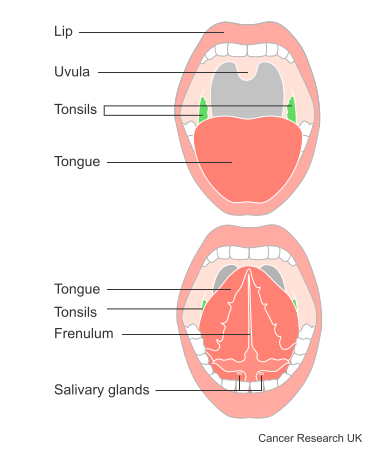
The medical term for the mouth is the oral cavity. Mouth cancer can start anywhere in the oral cavity. This includes the:
lips
inside lining of the cheeks and lips (buccal mucosa)
front two thirds of the tongue
gums (gingiva)
floor of the mouth
roof of the mouth (hard palate)
area behind the wisdom teeth (retromolar trigone)
The mouth and oropharynx help us breathe, talk, eat, chew and swallow.
The medical term for the throat is the pharynx. The pharynx is divided into 3 parts:
oropharynx
nasopharynx
laryngopharynx
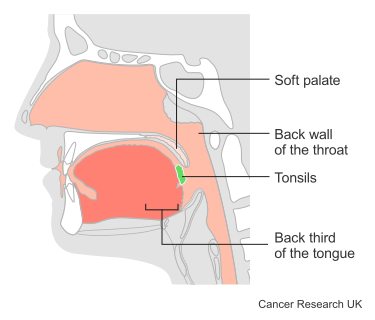
The oropharynx is the part of the throat just behind the mouth. Cancer starting in this area is called oropharyngeal cancer (pronounced oar-oh-fah-rin-jee-al).
The oropharynx includes the:
back one third of the tongue
soft area at the back of the roof of the mouth (soft palate)
tonsils and 2 ridges of tissue in front of and behind the tonsils (tonsillar pillars)
back wall of the throat
Lymph nodes are small bean shaped glands that are part of the . There are major groups of lymph nodes in your neck. Cancers starting in the mouth and oropharynx can spread to these because they are close by.
Your doctor examines your mouth and neck. You might also have tests to check for cancer in nearby lymph nodes.
You might have an operation to remove lymph nodes from the same side of the neck as the cancer. Rarely the surgeon might remove them on both sides. These operations are called neck dissections.
Cancer that starts in the lymph nodes is called lymphoma. This is very different to a mouth or oropharyngeal cancer that has spread to the lymph nodes.

The term throat cancer can be confusing because people use it to mean different types of cancer. People use the term to include the:
3 parts of the pharynx (oropharynx, nasopharynx, laryngopharynx)
thyroid
voice box (larynx)
food pipe (oesophagus)
To avoid confusion, it is important to know the exact type of cancer you have. Cancers are treated according to where they start in the body. Ask your doctor if you do not know the name of the type of throat cancer you have.
Oral cancer is more common in men than women. Research shows that 1 in 55 men and 1 in 108 women will be diagnosed with oral cancer at some point in their life.
Most HPV positive and non HPV oropharyngeal and oral cancers happen in people that are middle aged or elderly.
In the UK, more than 50 out of 100 (more than 50%) squamous cell oropharyngeal cancers are linked to the human papillomavirus (HPV). This is a common virus that causes no harm in most people. But in some people, the virus can cause changes in the throat, making them more likely to become cancerous in the future.
In recent years, there has been an increase of HPV positive oropharyngeal cancer.
Doctors test your oropharyngeal cancer cells to see if they contain the HPV virus. This affects the stage of your cancer and your outlook (prognosis). Oropharyngeal cancers containing HPV tend to have a better outlook than cancers that don’t.
Each year, around 8,900 new cases of mouth and oropharyngeal cancer are diagnosed in the UK.
Find out about the risks and causes of mouth and oropharyngeal cancer
Symptoms of mouth and oropharyngeal cancer include a mouth ulcer that doesn't heal or a swelling or lump in the neck.
We don't know what causes most mouth or oropharyngeal cancers. But there are some factors that can increase your risk of developing it.
Your GP will ask you about your symptoms and they might examine you. They may arrange tests or a referral to a specialist.
You have a number of tests to check for mouth and oropharyngeal cancer. This includes a nasoendoscopy and taking a sample of tissue called a biopsy.
The stage of a cancer tells you about its size and whether it has spread. The type means the type of cell the cancer started from. The grade means how abnormal the cells look under the microscope.
Advanced mouth and oropharyngeal cancer is cancer that started in the mouth or oropharynx and has spread to another part of the body.
Your treatment depends on where in your mouth or oropharynx your cancer is, the type, how big it is, whether it has spread anywhere else in your body and your general health.
All treatments must be fully researched before they can be adopted as standard treatment for everyone.
Last reviewed: 08 Jul 2024
Next review due: 08 Jul 2027