Hodgkin lymphoma
Doctors use the Lugano classification system to stage Hodgkin lymphoma. There are 4 stages, from stage 1 to 4. Doctors can also simplify the staging into early, intermediate or advanced stage.
Doctors look at whether your lymphoma is on:
the same side of the diaphragm or
on both sides of the diaphragm
They also look at whether it is inside or outside the .
They will measure the size of the lymphoma. They do this by doing various tests, such as a CT or PET scan. Your doctor will also take your symptoms into consideration.
The diaphragm (pronounced dia-fram) is the big breathing muscle that separates the chest from the tummy (abdominal) area.
Doctors use the diaphragm as a guide because it is about halfway down the body.

Doctors look at whether your lymphoma is affecting your and organs inside the lymphatic system. These are called lymphatic sites. If it is affecting areas outside the lymphatic system they are called extranodal sites.
Lymphatic sites include a group of lymph nodes or an organ in the lymphatic system, such as the:
tonsils
Extranodal sites are sometimes called extralymphatic sites. They are outside the lymphatic system and include the:
lungs
liver
blood
kidneys
brain
Your doctor may use the letter E (for extranodal) after the stage number if you have lymphoma outside the lymphatic system. For example stage 1E. Your doctor or nurse can explain what this means for you.
Your doctor will add the letter B to your stage (for example, stage 1B) if you have any of the following symptoms:
heavy sweating at night
high temperatures that come and go, often at night
unexplained weight loss, more than a tenth (10%) of your body weight in the last 6 months
If you don't have any of these symptoms your doctor will add the letter A to your stage (for example, stage 2A).
People with B symptoms may need more treatment than those without them.
This means you have either:
lymphoma that is 10cm or more
lymphoma in the centre of your chest (mediastinum) which is a third of the width of your chest or bigger
This means that you have one of the following:
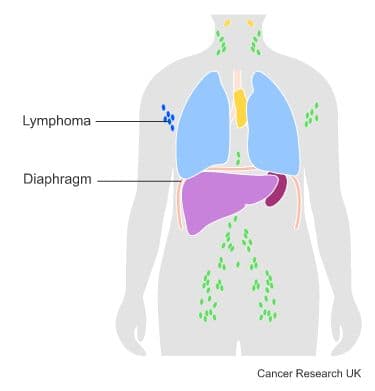
lymphoma in a single lymph node or one group of lymph nodes, or an organ of the lymphatic system (such as the thymus)
lymphoma in an extranodal site (this is called stage 1E)
Below is an example of stage 1 lymphoma.
This means one of the following:
your lymphoma is in two or more groups of lymph nodes
your lymphoma is in an extranodal site and one or more groups of lymph nodes (this is called stage 2E)
In both cases, the 2 sites of lymphoma are on the same side of the diaphragm.
Below is an example of stage 2.

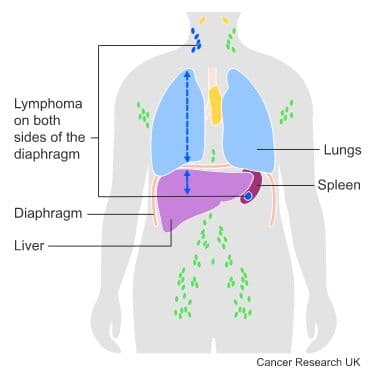
This means that you have lymphoma on both sides of the diaphragm.
Below is an example of stage 3. The lymphoma is in lymph nodes above the diaphragm and the spleen.
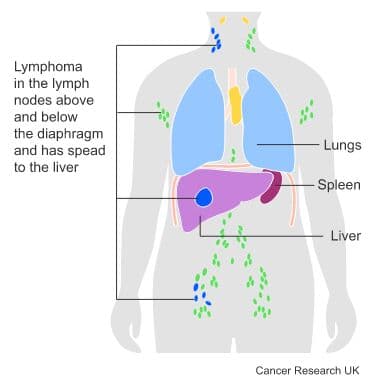
Stage 4 means one of the following:
lymphoma is in the lymph nodes and an extranodal site
lymphoma is in more than one extranodal site, for example the liver, bones or lungs
Below is an example of stage 4 lymphoma.
Your doctor may describe your lymphoma as being early, intermediate or advanced stage.
They will consider risk factors when deciding what stage your Hodgkin lymphoma is. The risk factors are:
having bulky disease in the centre of your chest (mediastinum)
being 50 years or older
if your red blood cells (erythrocytes) are sticking together (erythrocyte sedimentation rate or ESR
having lots of nodal areas with lymphoma
Early (limited) stage generally means you have stage 1 or stage 2 Hodgkin lymphoma with no risk factors. It is also called early stage favourable.
Intermediate stage usually means you have stage 1 or 2 with one or more risk factor. Your doctor might call this stage early stage unfavourable Hodgkin lymphoma.
Advanced stage generally means you have stage 3 or stage 4 Hodgkin lymphoma. However stage 2 with B symptoms and bulky disease or extranodal sites is usually treated as advanced stage (stage 2BX or 2BE).
Treatment for stage 1 and 2 Hodgkin lymphoma is usually 2 to 4 cycles of chemotherapy. You might also have radiotherapy.
Treatment for stage 3 and 4 Hodgkin lymphoma is usually between 4 to 6 cycles of chemotherapy. You might also have:
steroids
radiotherapy
targeted therapy
Treatment for nodular lymphocyte-predominant Hodgkin lymphoma (NLPHL) is mostly the same as classical Hodgkin lymphoma. However if you have stage 1A NLPHL with no risk factors you might have radiotherapy on it’s own. You will usually have a PET-CT scan after some treatment so your doctor can see if your lymphoma has changed.
Read more about the treatments for Hodgkin lymphoma
Hodgkin lymphoma that has come back after it has been treated and gone away is called recurrent or relapsed disease.
Your doctors will not stage it in the same way as when you were first diagnosed. You can still have treatment for relapsed Hodgkin lymphoma and this will often work well. Your treatment may include:
chemotherapy, usually a high dose
a
targeted therapy
immunotherapy
radiotherapy
For some people NLPHL can change (transform) into non Hodgkin lymphoma. If your doctor thinks your NLPHL has come back, you will have another biopsy and they will check if it has transformed. You will have different treatment if your lymphoma has transformed into non Hodgkin lymphoma.
Last reviewed: 18 Jun 2024
Next review due: 18 Jun 2027
The two types of Hodgkin lymphoma are classical Hodgkin lymphoma and nodular lymphocyte predominant Hodgkin lymphoma (NLPHL). There are also subtypes. Knowing the type helps your doctor choose the right treatment.
Hodgkin lymphoma treatment is usually very successful and most people are cured. The treatment you have depends on the type and stage of your Hodgkin lymphoma, as well as your general health. You might have more than one treatment.
Survival for Hodgkin lymphoma is generally good, particularly if you are diagnosed early. However survival depends on many factors and no one can tell you exactly how long you will live. Find out more about survival.
Get practical and emotional support to help you cope with a diagnosis of Hodgkin lymphoma, and life during and after treatment.
Hodgkin lymphoma is a cancer of a type of white blood cell called lymphocytes. Find out more about the tests, treatments and support available if you have Hodgkin lymphoma.
Hodgkin lymphoma is a cancer of a type of white blood cell called lymphocytes. Find out more about the tests, treatments and support available if you have Hodgkin lymphoma.