Surgery for rectal cancer
On the day of your operation, you need to do some things including stopping eating for a few hours. Your nurse will do some checks and your anaesthetist will give you an anaesthetic.
If you have any questions about your operation, the nurses can arrange for a member of the surgical team to come and talk to you. You sign a consent form for the operation if you didn't do it at the pre assessment clinic.
You might have a drip (intravenous infusion) put into your arm before your surgery so that you can have fluids through it. This makes sure you are not dehydrated before your operation.
Your nurse will check your blood pressure, pulse and breathing rate. They will go through a series of questions on a checklist to make sure you are ready for surgery. They ask you to:
tell them when you last had something to eat and drink
change into a hospital gown
put on a pair of surgical stockings
take off any jewellery (except for a wedding ring)
remove contact lenses if you have them
put on 2 hospital identification bands usually on each wrist
If you have false teeth you can usually keep them in until you get to the anaesthetic room.
For some types of surgery, you need to shave the skin over the operation area. Or your nurse can shave it for you. They might do this when you’re under anaesthetic in the operating room.
Your nurse might give you a tablet or an injection to help you relax. This will be an hour or so before you go to the operating theatre. This makes your mouth feel dry. But you can rinse your mouth with water to keep it moist.
Your nurse and a porter take you to theatre on a trolley if you’ve had this medicine. You can walk down to the theatre if you haven't had any.
You have an anaesthetic so that you can’t feel anything during the operation. You have this in the anaesthetic room or the operating theatre.
All the doctors and nurses wear theatre gowns, hats and masks. This reduces your chance of getting an infection.
You’re likely to have the operation under general anaesthetic. A general anaesthetic means that you will be in a deep sleep. When you wake up, the operation will be over.
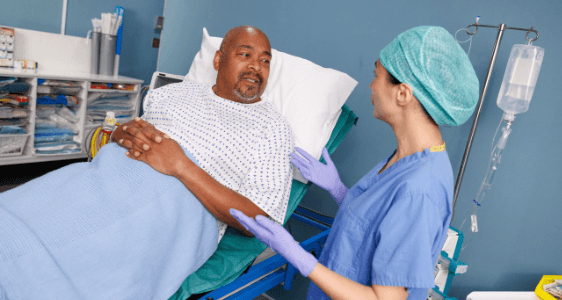
After the operation, you usually wake up in the recovery room. Once it’s safe to do so, you usually go back to the ward.
Find out what to expect when you wake up from rectal cancer surgery
Last reviewed: 03 Mar 2025
Next review due: 03 Mar 2028
The type of surgery you have for cancer of the back passage (rectum) depends on the position and the size of your cancer.
Before your operation for rectal cancer you will have some tests to check you are fit for surgery. You sign a consent form and meet members of the healthcare team who will be looking after you.
After a big operation, you might wake up in the intensive care unit (ICU) or high dependency unit (HDU). You are likely to have a drip into your arm to give you fluids until you are eating and drinking again.
Living with bowel (colorectal) cancer may mean you have changes to your diet, sex life or body image. There is support to help you cope.
Bowel cancer means cancer that starts in the colon (large bowel) or back passage (rectum). It is also known as colorectal cancer.

About Cancer generously supported by Dangoor Education since 2010. Learn more about Dangoor Education



Search our clinical trials database for all cancer trials and studies recruiting in the UK.

Connect with other people affected by cancer and share your experiences.

Questions about cancer? Call freephone 0808 800 40 40 from 9 to 5 - Monday to Friday. Alternatively, you can email us.
