Wear reflective gear: bright, neon or white clothing will help drivers spot you from afar.
Think low: car headlights are angled down slightly, so try to wear reflective socks or shoelaces.
Draw attention to your moving parts: wear reflective gear on your feet, ankles and wrists.
Use flashlights and headlamps: these light your way and alert people of your presence.
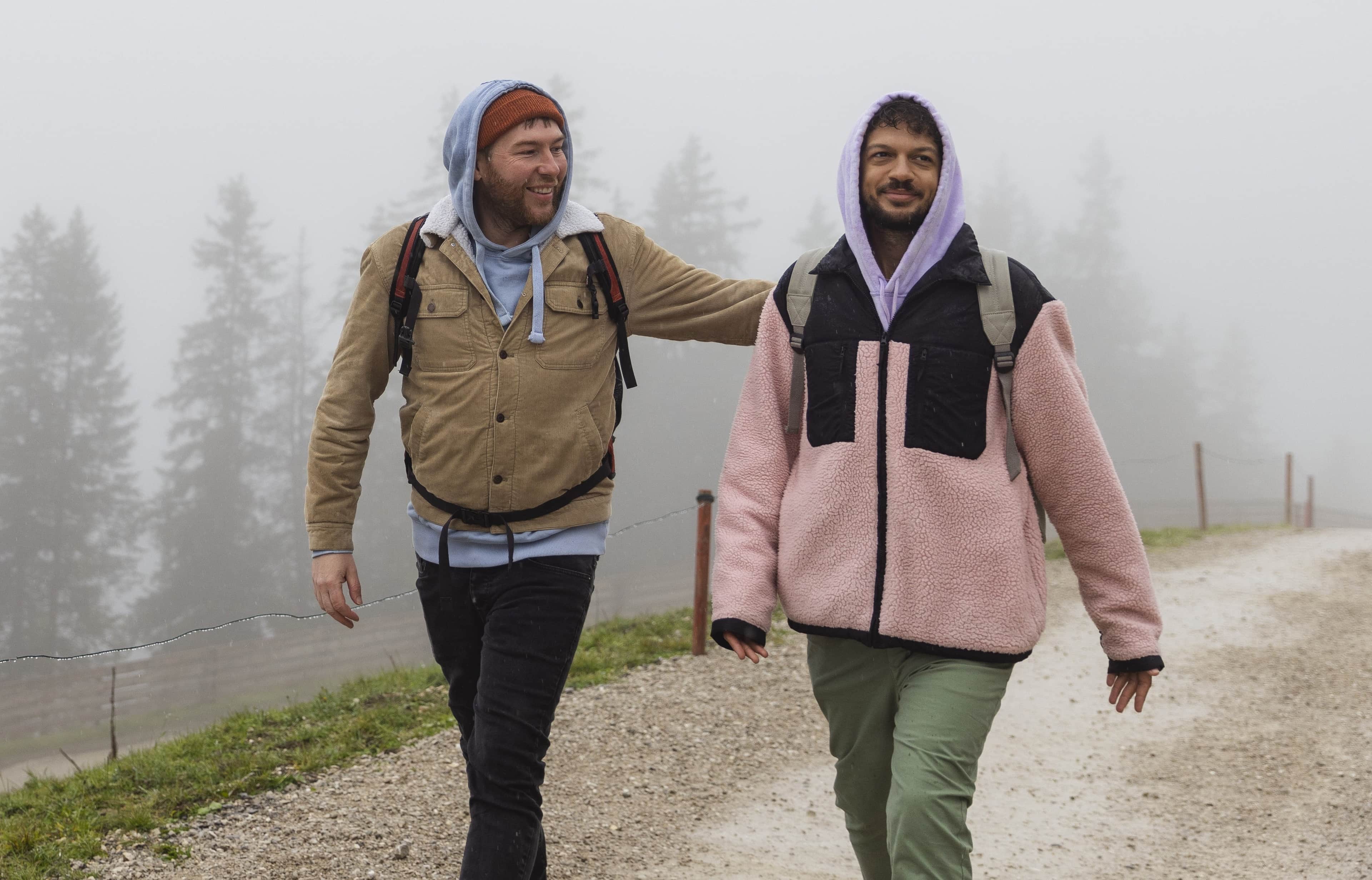
Wear layers: Multiple light layers can help keep your body insulated while allowing heat to circulate through your body without overheating. Your first layer should be moisture-wicking and a light fleece layer should keep you warm.
Cover your hands and ears: Avoid frostbite by covering these vulnerable areas on your body.
Get the right shoes: Make sure your shoe has more traction than a typical gym shoe. If it needs more traction, you can try ice cleats that you can add to the bottom of any shoe. Avoid mesh fabric.
Grab a scarf: If you have asthma, the cold air could agitate your lungs. Wrap the scarf over your nose and mouth.
Wear bright colours: Winter is known for dark mornings and afternoons. Wear bright clothing and reflective gear to make sure other people and cars see you walking.
Pick a safe route: Pavements with ice and snow can cause barriers to your route.
Warm-up: Do a few jumping jacks or high knees to warm your body up before you go outside.
Recover afterwards: This will help protect your muscles from cramping, soreness and dehydration.
It’s not unusual to encounter bad weather when walking in the UK, so it’s important to have the right equipment. Alternatively, you can complete the miles on a treadmill at home or the gym.
When walking in adverse weather, remember to check and know your route. Understanding your surroundings will help you avoid difficult terrain and make sure you stick to safer, flat surfaces.
Here's some useful equipment to consider:
Waterproof clothing.
Walking shoes/boots and walking socks.
Warm clothing and layers (thermals, gloves, hats, fleece, long trousers).
Water and food.
Mobile phone.
The Walk 62 Miles in January challenge invites supporters to raise funds for Cancer Research UK by committing to walk a total of 62 miles throughout the month of January.
Participants have the flexibility to complete the miles in a way that suits their lifestyle. For example:
They can walk 2 miles per day to reach the goal steadily.
Alternatively, they can opt for longer walks on weekends or mix shorter and longer walks across the month.
The key is to complete the 62-mile target by the end of January while actively fundraising to support life-saving cancer research.
Once you’ve signed up, join the Facebook Group dedicated to this challenge and click 'Join Group'. Once you're in, you can complete a form to get your free bobble hat, get tips for completing your challenge, be inspired by other fundraisers and find out anything you want to know.
Yes! If you don’t have Facebook, you can set up a Cancer Research UK online Giving Page and collect sponsorship for your Walk 62 Miles Challenge.
There is no entry fee for this challenge, but we do ask that you fundraise for Cancer Research UK through your online Giving Page. All donations to the page will automatically be sent to us.
Whilst we encourage everyone to complete this challenge throughout the month of January, this is a personal challenge, and you can start and finish your challenge at any time that is convenient for you. You can complete your walks at any point in the month and continue the challenge into February.
It is more than ok for you to complete the miles inside on a treadmill at home/the gym, if that’s an option for you. However you choose to break down the 62 miles, you’ll be helping to beat cancer.
We’ll be sending a digital calendar along with your fundraising pack to help you track your miles. We also recommend the Strava and Fitbit apps, which you can easily link to your online Giving Page. Alternatively, your phone will have plenty of free pedometer apps, or you could buy a cheap one from your local gym or running shop.
62 miles equates to roughly 2 miles a day. 2 miles also equates to about 4000 steps which can be achieved by most without extreme physical activity. Depending on an individual’s walking pace, this should be achievable by walking 30-60 mins daily.
There are plenty of ways you can hit your weekly target – attempt to make up the numbers with a couple of shorter walks, or save them for a big walk at the weekend!
The only thing that matters is that you try your best to complete as much of the challenge as you can. Whether that’s completing 62 miles in January or not, the money that you raise will allow us to keep funding life-saving research. Whatever you manage to achieve, we can’t thank you enough.
We trust you! You don’t need to provide evidence that you’ve completed the challenge to us, but your friends and family will want some updates. Make sure you keep them posted on your progress and share videos and photos throughout January – the more updates the better. Supporters who regularly post their progress raise 40% more on average. We recommend you connect your Giving Page to Fitbit or Strava so you can track your steps or miles automatically. Please note: With Strava there is sometimes a 48-hour lag in the data being updated. If your miles still aren't showing, disconnect and reconnect to do a hard reset and this will add any miles already on your Strava account.
Absolutely! If you’ve set up a Giving Page, it’ll remain active so your supporters can continue to donate for as long as you want to keep going.
Complete this form to receive your free bobble hat in the post. Once completed, please allow 10 working days for it to arrive. If you haven’t received your bobble hat after this time, please contact supporter.services@cancer.org.uk.
When filling out your sign-up form, select ‘no’ where it asks if you’d like to receive a bobble hat. You’ll still receive an online Giving Page, be able to join the challenge group and take part! Sign up to the challenge If you have any further questions, please email supporter.services@cancer.org.uk or call 0300 1231022 (lines open 8am–8pm, Monday to Friday and 9am–5pm at weekends)
Sending out your bobble hats comes at a cost to us, so please only order one bobble hat per fundraiser to make sure as much money as possible goes towards our life-saving work. We ask that everyone requesting a bobble hat donates something to their fundraising page. Alternatively, you can purchase additional bobble hat from our online shop.
You’ll be sent a certificate in your completion email at the end of your challenge. You can also access downloadable digital badges to shout about your achievement on social media. Unfortunately, medals would cost us a significant amount, so we won’t be sending these out so we can spend more on our life-saving work.
Yes, under-18s can take part in this challenge, but we don’t market to them and any third-party platform forums (such as Facebook forums) are only available to people over 18. If under-18s are taking part, their parent or guardian must consent to the child’s participation, supervise the challenge and accept responsibility for complying with the challenge rules. If a child wants to raise money online and/or join a forum, the child’s parent or guardian must register for an online fundraising page and/or join the forum on the child’s behalf.
Participants must register as individuals, but you can then set up a team Giving Page to take on the challenge and raise money together.
Here’s how:
All your team will need to sign up to the Walk 62 Miles in January Challenge so you each have your own online Giving Page.
Once everyone has signed up, log into your account.
Hit the 'Create new team' button and follow the instructions.
Once you've created your team, you can send the team page URL to friends and family so they can join too!
Find more information about setting up a team.
Once you’ve set up your team, you can either split up your miles between the group or you can all complete the miles individually across the month.
Using our Online Fundraising Platform is the easiest way to raise money. You will receive an online Giving Page once you’ve registered here: https://activities.cancerresearchuk.org/walk-62-challenge-jan-2026 You can then share the page with your friends and family to gather sponsorship for your challenge.
We don’t set a fundraising target for participants, but we recommend that supporters set themselves a reasonable target of raising £150 or more.
The first tip is to log in to your page and take a few minutes to personalise it. You can add a photo, update the 'My Story' section to share why raising funds for this cause is important to you.
Second tip is, if you're able to, kick-start the fundraising by adding your own donation to your Online giving page. It can often help to get things going - it's a bit like making sure your friends aren't the first guests at a party.
And the third and final tip is to share a post on your social media channels (Facebook, Instagram, anything you use) to tell people about your challenge - and make sure to share the link to your Online giving page in the post.
Remember, any donation can make a difference. As little as £3 could buy a pair of safety goggles to keep our scientists safe while they conduct their cutting-edge experiments.
Let us know how you get on by posting on the group, and we can offer further help if you want it. You've got this!
£5 can fund a lab technician for over 30 minutes, ensuring researchers are equipped with everything they need to beat cancer.
£10 can buy 250 plastic test tubes to help carry out cancer-fighting experiments.
£15 can buy agarose gel, which is a vital component for a technique that scientists use to measure the length of pieces of DNA.
£20 could buy antibiotics to keep the cells studied by our scientists free from infections.
Yes absolutely! You can raise your fundraising target on your online Giving Page at any time. Supporters who increase their fundraising target raise an average of 51% more than those who don’t, so why not head over to your page and raise yours!
We have plenty of fundraising materials and ideas to help you raise life-saving donations. Visit our fundraising hub for everything you need for your challenge.
This challenge is a fundraising initiative specifically developed by us, therefore all money raised must go solely to Cancer Research UK.
Gift Aid is a tax relief allowing UK charities to reclaim an extra 25% on every eligible donation made by a UK taxpayer. This means Cancer Research UK can claim an extra 25p for every £1 donated, without it costing you or your sponsors an extra penny. For a donation to be eligible for Gift Aid, sponsors need to fill out the sponsorship form following the instructions at the top of the page.
