Getting diagnosed
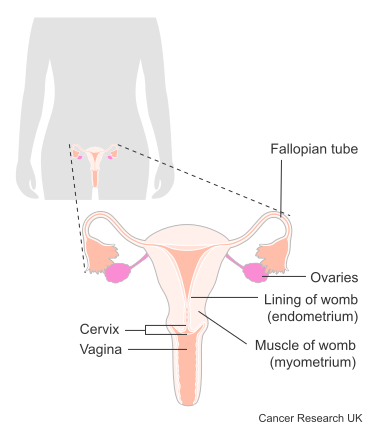
The womb is the pear shaped muscular organ that holds and protects a baby during pregnancy. It is part of the female .
Most people with symptoms that could be due to cancer start by contacting their GP surgery. Your first appointment may be a telephone appointment. Your GP surgery then might arrange for you to go in and see a doctor or other healthcare professional.
Read about the symptoms of womb cancer
Your GP can do some tests to help them decide whether you need to see a specialist. This usually includes:
a physical examination
blood tests
Depending on your symptoms and test results, your GP might also request other tests.
Your GP usually does a physical examination. This includes looking at and feeling your:
tummy (abdomen)
Your doctor feels for any areas that are swollen or might not feel normal. They might also do a pelvic examination.
A pelvic examination is also called a:
pelvic exam
vaginal examination
internal examination
Some people feel uncomfortable and embarrassed when having some of these tests. They may also be painful, which is distressing. Your GP or specialist will try to make you as comfortable as possible.
If you want, you can ask for someone else to be in the room with you to act as a chaperone. A chaperone is a trained healthcare professional such as a nurse. A friend or relative can also stay with you for support and comfort. They can be with you during the test or examination.
Before any examination, your GP or specialist will explain what they are going to do. Ask them if you are not clear about anything.
To have this test, you usually lie down with your knees up and legs apart. You may be asked to rest your legs on padded leg supports.
Your doctor uses a to gently open your vagina. They look at the vagina and cervix to see if there is anything abnormal. Your doctor may use a strong light and magnifier.
They may also put two gloved fingers into your vagina. They then press down on your abdomen at the same time with their other hand. They feel for any lumps or abnormalities. Your doctor may also check your rectum (back passage). They can feel for any lumps or changes in size or shape.
Read more about having a pelvic examination
Blood tests can check your general health including:
how well your liver and kidneys are working
checks the number of such as and
Depending on your symptoms, they may also ask you to have other types of blood tests.
Find out more about having blood tests
Depending on the results of your tests, your GP might refer you to a specialist doctor at the hospital. This is usually a gynaecologist.
Your specialist usually does more tests. These include:
an ultrasound scan
taking a sample of tissue from your womb called an endometrial biopsy
a CT scan
a MRI scan
Ultrasound scans use high frequency sound waves to create a picture of the inside of your body.
The ultrasound scanner has a probe that gives off sound waves. The sound waves bounce off the organs inside your body, and the probe picks them up. The probe links to a computer that turns the sound waves into a picture on the screen.
You usually have an ultrasound scan of the lower part of your abdomen. This is an external ultrasound. This is when the doctor or a specialist healthcare professional called a sonographer moves the ultrasound probe over your skin.
Read more about having a pelvic ultrasound scan
You may also have a vaginal ultrasound scan. This is when your doctor or sonographer gently puts an ultrasound probe into your vagina. A vaginal ultrasound is also called an internal ultrasound or transvaginal ultrasound (TVS).
Read more about having a transvaginal ultrasound scan
A biopsy is the only way to find out for sure if you have womb cancer. A biopsy of the womb is also called an endometrial biopsy. Your doctor takes a sample of tissue from the womb and sends the sample to the laboratory. A specialist doctor called a pathologist checks the sample for cancer cells.
There are different ways to have a womb biopsy. The most common way is to have an aspiration biopsy.
You usually have an aspiration biopsy in the outpatient clinic. Your doctor uses a speculum to gently open your vagina. Then they put a long thin tube into the womb through your vagina. They use gentle suction to draw some of the cells into the tube.
You may have some period type pain during and after an aspiration biopsy. Speak to your doctor if you have any pain. They can give you some mild painkillers to help control the pain.
Your doctor may suggest you have a hysteroscopy if you can’t have an aspiration biopsy for any reason. They use a very thin camera called a hysteroscope to look into your womb and take a biopsy.
Find out more about having a womb biopsy
A CT scan uses x-rays and a computer to create detailed pictures of the inside of your body. The computer puts them together to make a 3 dimensional (3D) image.
You usually have a CT scan of your chest, abdomen and pelvis. This helps to find out where the cancer is and whether it has spread ().
Read more about having a CT scan
MRI stands for magnetic resonance imaging. It uses magnetism and radio waves to take pictures of the inside of the body.
An MRI can tell your doctor:
where the cancer is and how big it is
whether it has spread to the
Find out more about having an MRI scan
The tests you have help your doctor find out if you have womb cancer and how far it has grown. This is the stage of the cancer.
Read about the stages of womb cancer
This is important because doctors recommend your treatment according to the stage of the cancer.
Find out about the treatment options for womb cancer
Cancer affects people in different ways. Coping with a diagnosis of womb cancer can be difficult for some people. There is help and support for you and your family.
Read about what you can do to cope with a diagnosis of womb cancer
Last reviewed: 27 Feb 2024
Next review due: 27 Feb 2027
You may hear womb cancer being called uterine cancer. The endometrium is the lining of the womb. Endometrial cancer is the most common type of womb cancer.
The most common symptom of womb cancer is abnormal bleeding from the vagina. This is especially in women who have stopped having periods (post menopausal women).
Your treatment depends on several factors. These include what type of womb cancer you have, how big it is, whether it has spread (the stage) and the grade. It also depends on your general health.
A womb biopsy is when a sample of tissue is taken from the lining of the womb. This is also called an endometrial biopsy.
Find out about tests to diagnose cancer and monitor it during and after treatment, including what each test can show, how you have it and how to prepare.
The womb is the pear shaped muscular bag that holds a baby during pregnancy. Most womb cancers start in the lining of the womb. They are also called uterine or endometrial cancer.