Types
Oligodendrogliomas develop from glial cells called oligodendrocytes. These cells make a fatty white substance (myelin) that covers the nerves. Myelin helps signals (impulses) to travel along the nerves more quickly.
Oligodendrogliomas are mostly found in the frontal lobe of the cerebrum. They can also start in the spinal cord, but this is rare.
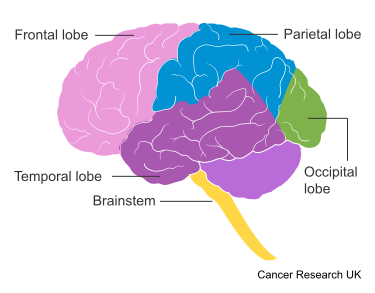
Rarely, oligodendrogliomas can spread to other parts of the brain and the spinal cord.
Find out more about the different parts of the brain and spinal cord
Doctors use a system to group (classify) brain tumours into different groups and types. The World Health Organisation (WHO) regularly update this system. The information on this page is based on the latest WHO classification of 2021.
Oligodendrogliomas are a type of brain tumour that belongs to a group of brain tumours called gliomas.
Doctors have changed the way they group and describe different gliomas. All oligodendrogliomas are now called:
oligodendroglioma, IDH mutant and 1p/19q co-deleted
Your doctor looks to see if there are certain gene changes in the brain tumour cells. These tests are also called biomarkers or molecular studies. Your doctor uses these test results to decide what type of glioma you have.
IDH (isocitrate dehydrogenase) is a gene. Your doctor looks for permanent changes (mutations) in the IDH gene.
1p and 19q refer to chromosome 1 and chromosome 19. 1p/19q co-deleted means that:
part of the short arm (p) of chromosome 1 is missing (deleted)
part of the long arm (q) of chromosome 19 is missing (deleted)
Your doctor diagnoses you with an oligodendroglioma if the glioma cells:
have changes (mutations) in the IDH gene – this is what IDH mutant means
are missing parts of chromosome 1 and chromosome 19 – this is what 1p/19q co-deleted means
Symptoms of oligodendroglioma depend on where the tumour is in the brain.
Common symptoms include:
seizures (fits)
headaches
weakness and numbness in your arms and legs
feeling or being sick
Find out more about the symptoms of brain tumours
Oligodendrogliomas are put into groups based on how quickly they are likely to grow. This is called the grade.
Generally, the more normal the cells look, the lower the grade. The more abnormal the cells look, the higher the grade. Grade also depends on genes and proteins in the tumour cells.
There are 2 grades of oligodendrogliomas:
grade 2 (low grade), sometimes called diffuse
grade 3 (high grade), sometimes called anaplastic
Read more about the grades of brain tumours
Oligodendrogliomas are rare. About 3 out of every 100 primary brain tumours (about 3%) diagnosed in England between 1995 and 2017 were oligodendrogliomas.
You have tests to diagnose an oligodendroglioma. Your doctor checks the size of the tumour and its location. This helps your doctor plan your treatment. The tests you might have include:
or
a
a test of your neurological system (neurological examination)
We have more information about the tests you might have to diagnose a brain tumour
Treatment depends on whether the oligodendroglioma is low grade (slow growing) or high grade (fast growing).
The main treatments for oligodendroglioma are:
surgery to remove as much tumour as possible
radiotherapy
chemotherapy
If the tumour comes back the treatment you have depends on your previous treatment. Your doctor or nurse will talk to you about your options.
These treatments can slow down the growth of the tumour and help you feel better.
chemotherapy with lomustine, temozolomide or PCV
more surgery
more radiotherapy
Find out more about these cancer drugs by going to the A to Z list
A brain tumour can affect your ability to drive. You may not be allowed to drive for some time after your diagnosis or treatment.
Ask your doctor or specialist nurse how your brain tumour might affect your right to drive.
You have regular appointments with your doctor or nurse after treatment finishes. Your doctor examines you at each appointment. They ask how you are feeling, whether you have had any symptoms or side effects, and if you are worried about anything. You might also have MRI scans on some visits.
How often you have checks ups depend on your individual situation.
You might have an MRI scan every 3 to 6 months, for two years. You then have an MRI scan every year or every 2 years.
Read more about follow up appointments after treatment for a brain tumour
Coping with a diagnosis of a brain tumour can be difficult, both practically and emotionally. It can be especially difficult when you have a high grade tumour. Being well informed about the type of tumour you have, and its treatment can make it easier to cope.
Find out what you can do, who can help and how to cope with a brain tumour
Doctors are always trying to improve the diagnosis and treatment of brain tumours. As part of your treatment, your doctor might ask you to take part in a clinical trial. This might be to test a new treatment or look at different combinations of existing treatments.
Find out about the latest UK research and how you can take part in a clinical trial
Last reviewed: 13 Jul 2026
Next review due: 13 Jul 2029
Primary brain tumours are tumours that start in the brain. They can start anywhere in the brain and there are many different types of tumours.
Common symptoms of brain tumours include headaches, feeling or being sick and seizures (fits).
Treatment for a brain or spinal cord tumour depends on the type of tumour you have, where it is and your general health.
Survival depends on different factors such as the type, position and grade of your brain or spinal cord tumour.
It can be difficult to find out that you have a brain tumour. There is practical and emotional support available to help you, your family and your friends cope with a brain or spinal cord tumour.